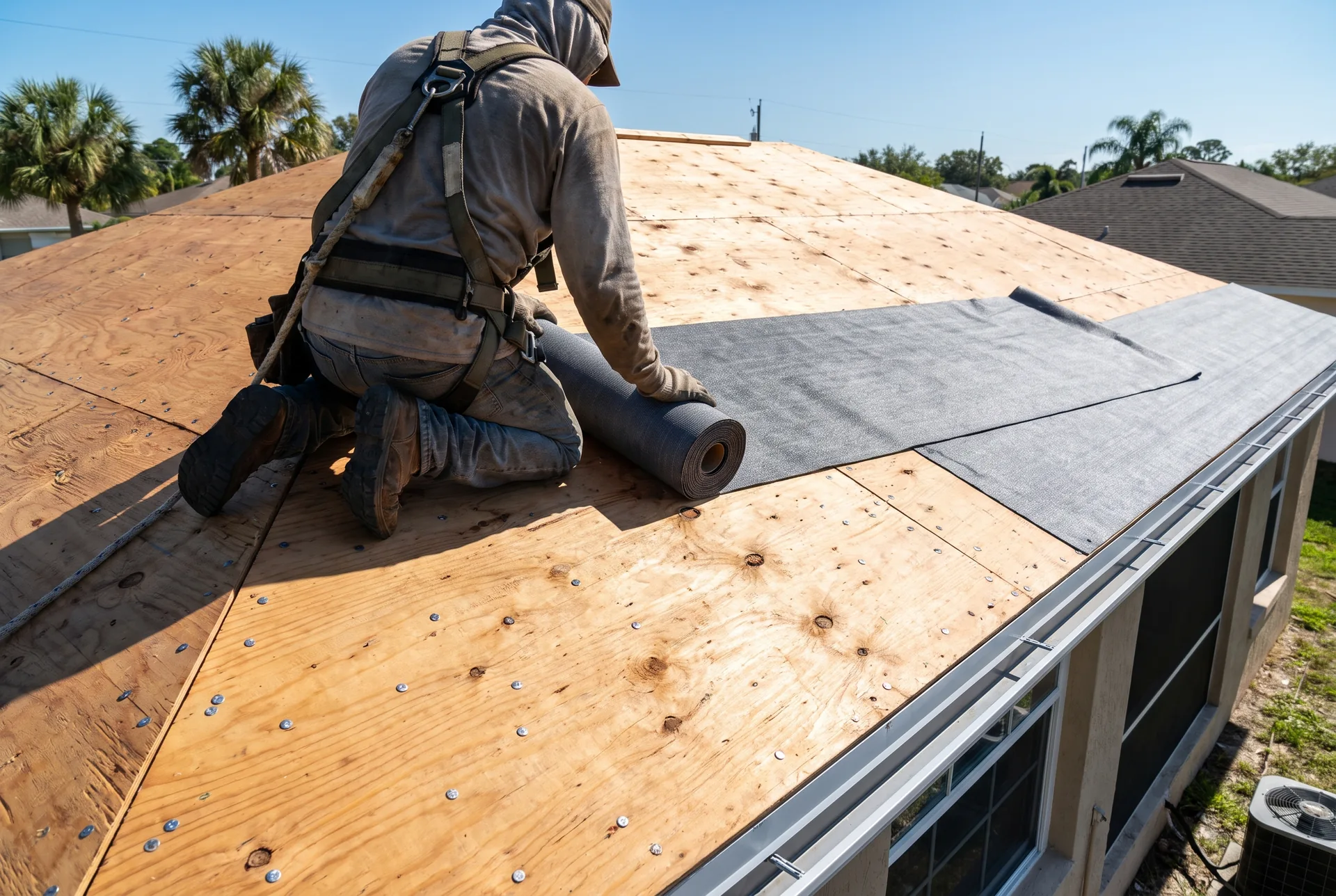
My Safe Florida Home is the state program that pays part of the cost of making older homes more wind-resistant — and a roof replacement built to current code is exactly the kind of work it's designed for. Here's how it works as of the 2025–2026 cycle.
The basics
- Free wind mitigation inspection. The program sends a certified inspector to check your roof deck attachment, roof-to-wall connections, roof covering, secondary water barrier, and window, door and garage-door protection. No obligation.
- Matching grant. The state pays $2 for every $1 you spend on qualifying improvements, up to $10,000 of state money (so a $15,000 qualifying project gets $10,000). Low-income homeowners can qualify for the full $10,000 with no match.
- Funding. The program reopened on August 4, 2025 with $352 million for 2025–2026, released to applicants in priority order: low-income homeowners 60 and over first, then low-income of any age, then moderate-income 60-plus, then moderate-income. Additional funding was carried into the 2026–2027 budget.
Who qualifies
- The home is your primary residence with an active Florida homestead exemption.
- It's a single-family detached home, a townhouse of three stories or fewer, or a qualifying townhouse-style condo.
- The building permit for the home was issued before January 1, 2008.
- It's insured for $700,000 or less (the cap doesn't apply to low-income applicants).
- It's in Florida — the program isn't limited to the coast, but Cape Coral, in the wind-borne debris region, is exactly the kind of place it targets.
What roof work counts
The program pays for the wind-mitigation improvements the inspection recommends — not for a roof simply because it's old. On a re-roof that means: improving the roof deck attachment (re-nailing to code), installing a secondary water barrier (self-adhered underlayment or a sealed deck), strengthening roof-to-wall connections (clips or straps where accessible), and replacing the roof covering when it's done together with those improvements. Opening protection — impact windows, doors and garage doors — also qualifies. Our replacement quotes itemize the qualifying items so the program paperwork is straightforward.
The sequence, so you don't lose the grant
- Apply at the program's site and get the free inspection.
- Submit the prioritization questionnaire. Tens of thousands of homeowners had the inspection and never filed this step; without it, no grant is issued.
- Get your grant approval letter and the list of eligible improvements.
- Hire a licensed contractor — us, for the roof — and complete the work. Don't start before approval.
- Final inspection, then submit the reimbursement request with our invoice, the permit and the photos.
How it fits a Cape Coral roof
A 1980s or '90s Cape Coral home with its original roof is the program's target: pre-2008 permit, homesteaded, and a roof that lacks a secondary water barrier and modern deck nailing. A code-built replacement — shingle, tile or metal — supplies every roof item on the list. With a $10,000 state contribution, a $20,000 shingle roof or a $28,000 re-underlayment gets materially cheaper, and the wind mitigation credits on the finished roof reduce the premium on top of it. We've done the paperwork before; ask and we'll walk you through it.
Program terms, funding and deadlines change from cycle to cycle. Confirm current details at the Florida Department of Financial Services' My Safe Florida Home site before you rely on them.
Related questions
Is the program open right now?
It reopened August 4, 2025 with $352 million for the 2025–2026 cycle, released in income and age priority tiers, and the Legislature carried additional funding into 2026–2027. Check the state's program site for the current window; the queue moves in the priority order above.
Does the grant pay for a whole new roof?
It pays for the wind-mitigation items — deck attachment, secondary water barrier, roof-to-wall connections — and the roof covering when it's replaced together with them, up to $10,000 of state money on a 2-to-1 match. On most re-roofs that covers a meaningful part of the total.
My house was built in 2004. Do I qualify?
Yes on the permit date (before January 1, 2008) if the other conditions are met — homestead, primary residence, insured value under $700,000 unless low-income.
Can I start the roof before the grant is approved?
No. Work done before approval isn't reimbursed. Get the inspection, file the questionnaire, get the approval letter, then schedule.
Do you handle the program paperwork?
We provide what the program needs from the contractor: the itemized quote with qualifying items, the permit, the final inspection and the invoice. You submit the application and the reimbursement request; we'll walk you through it.
Does the grant affect my insurance credits?
Only for the better — the improvements it funds are the same items on the wind mitigation form, so you get the grant and the premium credits.